.png)

karel
Call
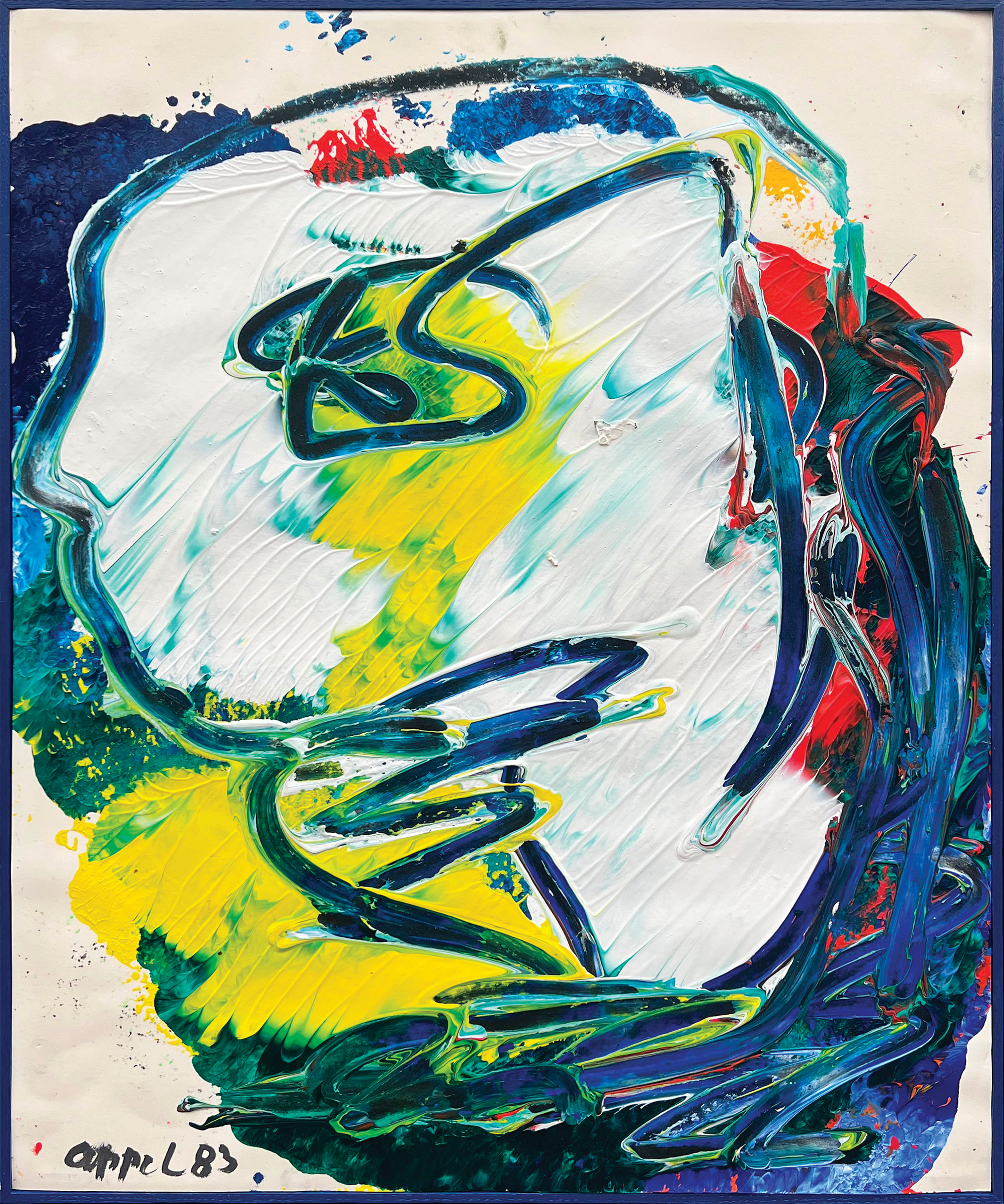
Karel Appel (1921—2006) is one of the major figures of the post-war European avant-garde. A Dutch painter and sculptor, he developed a work based on the energy of the gesture, the thickness of the material and a deliberately primitive figuration, affirming a radical break with the aesthetic conventions inherited from academicism.
Trained at the Royal Academy of Fine Arts in Amsterdam during the 1940s, Appel moved away from academic teaching at an early age to defend an instinctive and immediate creation. In 1948, he was one of the founding members of the CoBrA movement, alongside Christian Dotremont, Asger Jorn and Constant in particular. This group claims total freedom of gesture, nourished by children's art, folk art and so-called primitive forms, in opposition to any excessive intellectualization of art.
In 1949, the creation of the mural Questioning Children at the Stedelijk Museum in Amsterdam causes a resounding scandal. This work, which was quickly withdrawn, marks a key moment in the history of CoBrA and affirms the radicality of Appel's language, based on the expressive violence of color and the voluntary deformation of the figure. It is one of the major milestones in post-war European painting.
From the beginning of the 1950s, Karel Appel became a permanent part of the international artistic scene. He participated in group exhibitions and major avant-garde events, in particular the Venice Biennale, helping to place European gestural painting in a direct dialogue with American abstract expressionism. His work then evolved towards more monumental formats and accentuated pictorial materiality. Painting is built through thick superimpositions, accumulations of material and broad gestures, where color acts as a dense and active substance. Impasto becomes a structuring principle of the surface, giving the canvas an almost sculptural presence.
During the 1950s and 1960s, the central period of his career, Appel developed a fully assertive language, situated at the border between abstract expressionism and assumed archaic figuration. Human and animal forms, reduced to elementary signs, emerge directly from matter without classical compositional organization. Painting and sculpture unfold jointly in a search for immediacy, physicality and the intensity of the act, making Appel one of the European artists who most radically affirmed a conception of art as an act and as energy.
Karel Appel's work is now preserved in leading institutions, in particular the Stedelijk Museum in Amsterdam and the National Museum of Modern Art — Centre Pompidou in Paris. This institutional recognition confirms its central place in the history of the post-war European avant-garde and its decisive role in the assertion of painting freed from traditional frameworks, at the crossroads of CoBrA and abstract expressionism.
The artist's work is largely preserved and celebrated by the Karel Appel Foundation. His paintings, drawings and sculptures have been exhibited in the largest international museums. The Palais des Beaux-Arts in Brussels has hosted exhibitions showcasing his exceptional creative talent. In 2015, the Pompidou Center organized a Exceptional Retrospective of Appel's work.