.png)

Christine
Boumeester
Christine Boumeester was born in 1904 in Jakarta into a family that had lived in Indonesia for five generations. She discovered Europe for the first time in 1914, then settled permanently in the Netherlands in 1921. Between 1922 and 1924, she studied at the Royal Academy of Fine Arts in The Hague.
In 1935 she moved to Paris. Enrolled at the Académie de la Grande Chaumière, she met Henri Goetz there, whom she married a few months later. The same year, she exhibited for the first time at the Salon des Surwith Goetz and Hans Hartung. Its Paris network is expanding rapidly. Through Julio González, she frequented the world of surrealists, Óscar Domínguez, André Breton and the poets Juan Breá and Mary Low. Then thanks to Hartung, who shared their studio, she met Vassily Kandinsky and turned to abstraction.
As early as 1939, she was represented by the Jeanne Bucher Gallery, a major institution on the modern scene. She rubbed shoulders with Maria Helena Vieira da Silva, Árpád Szenes, César Domela, Wifredo Lam and Pablo Picasso.
During the Second World War, Boumeester and Goetz joined the Resistance. Refugees in Carcassonne in 1940-1941, they joined the Belgian surrealists Raoul Ubac, René Magritte and Louis Scutenaire. With Ubac and Christian Dotremont, they secretly founded the magazine The Feather Hand. Denounced for having manufactured false papers intended for Jews and resistance fighters, they lived under assumed names and took refuge in Nice. It was there that she became friends with Francis Picabia, Jean Arp, Jean Arp, Alberto Magnelli and Nicolas de Staël, whom she accompanied in 1942 in the realization of her first abstract work.
In 1949, she founded the Ateliers d'Art Abstrait. This place of transmission welcomes young artists, including Zao Wou-Ki. There she taught a rigorous conception of painting, based on the balance between construction and spontaneity. At the same time, she joined the Graphias group (1949-1952) and exhibited regularly at the Colette Allendy gallery, then abroad in Amsterdam, London, Geneva and Milan.
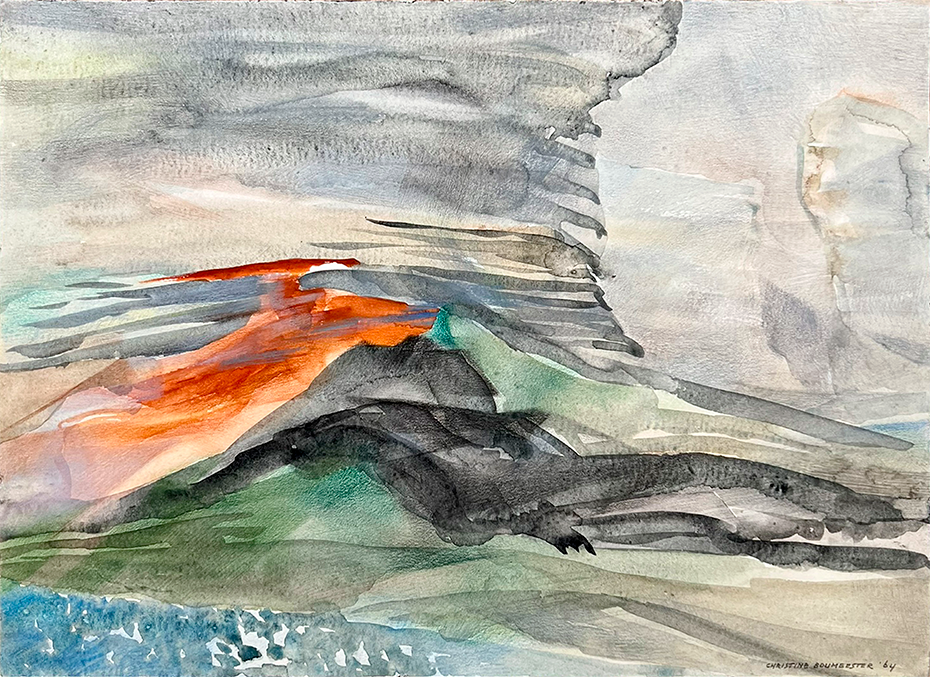
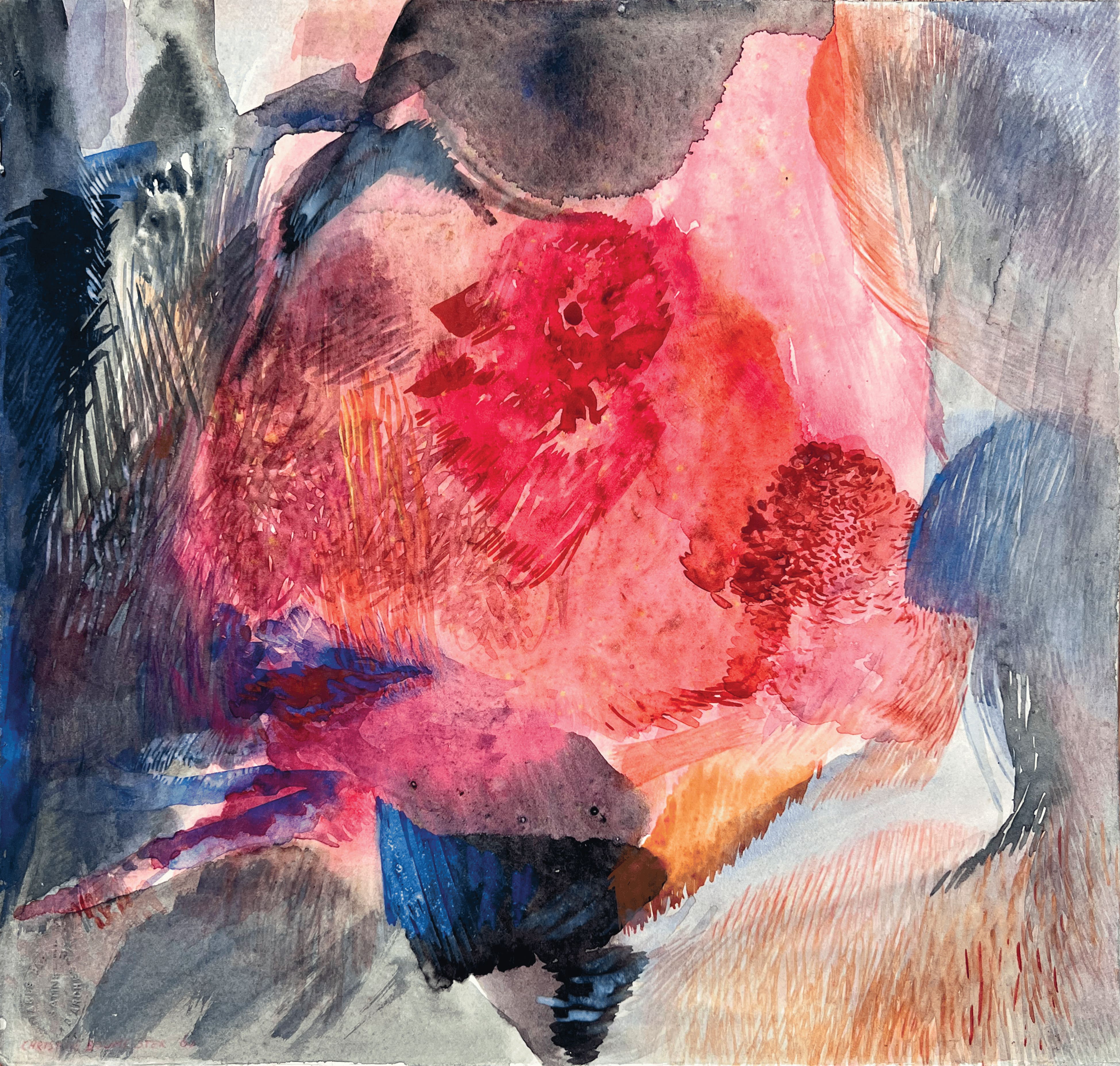
In the 1950s and 1960s, his canvases combined networks of dynamic lines with colored masses in suspension. The whole creates a space that is both lyrical and architectural. Color, through subtle contrasts and chromatic vibrations, structures the composition. Deep blacks and delicate gradations give his work a singular poetry. In 1962, the philosopher Gaston Bachelard praised in a preface “the secret of such creations”, where “the colorful masses under his amused eyes believed that they could put at peace, in the light of day, the violent struggles of the night world”.
Christine Boumeester on January 3, 1971. Henri Goetz published his diaries in 1977 under the title The Notebook by Christine Boumeester. In 1983, the Goetz-Boumeester Museum opened in Villefranche-sur-Mer, dedicated to the couple's work. Today, his works are preserved in the largest institutions, including the Pompidou Center, the Museum of Modern Art in the city of Paris, the Picasso Museum in Antibes, the Stedelijk Museum in Amsterdam and the Museo d'Arte Contemporanea in Sao Paolo. Recent research in art history reassesses the importance of this figure, whose influence — through painting, teaching, translation and theoretical commitment — has permanently marked the formulation and transmission of the principles of abstraction in the 20th century.