.png)

Sam
Francis
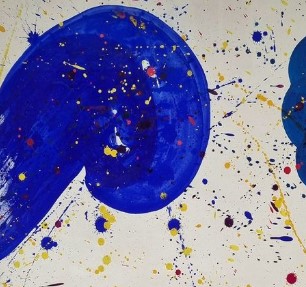
Born in 1923 in California, Sam Francis has established himself as one of the major representatives of American abstract expressionism and Action Painting. His work is part of a painting of gesture, spontaneity and color, where the pictorial act becomes a physical and mental experience.
An aviator during the Second World War, he was seriously injured in a plane crash. It was during his convalescence that he began painting, a founding experience that permanently marked his relationship with creation. He then trained at the University of California at Berkeley, where the teaching of Clyfford Still played a decisive role, encouraging him to simplify forms and to explore color as an autonomous structure, free from figuration.
In 1949, Sam Francis moved to Paris and attended the Fernand Léger Academy. He quickly integrated into international artistic networks and exchanged with critics and major artists of his time, including Pierre Schneider, Joan Mitchell or Jean-Paul Riopelle. This European period was decisive in the development of his pictorial language.
Back in the United States, his interest in light and space led him to explore dripping, in a personal dialogue with the legacy of Jackson Pollock, and then to deepen the question of color and the dissolution of forms, especially following his encounter with Mark Rothko. A trip to Japan in 1957 further enriched his research, leading him to vertical formats and an increased simplification of composition, in resonance with the aesthetics of kakemono.
From the mid-1950s, his work was represented by major galleries and quickly integrated the collections of the largest international institutions, including the Pompidou Center, the Tate Gallery, the Solomon R. Guggenheim Museum, the MoMA, the MoMA, the Tel Aviv Museum of Art and the Tokyo Fuji Art Museum. The work of Sam Francis today occupies an essential place in the history of 20th century abstraction, through his decisive contribution to the painting of color, light and space.
.jpg)