.png)

Serge
Poliakoff
Born in 1900 in Moscow, Serge Poliakoff settled in Paris in the 1920s, gradually integrated into artistic circles while developing a largely self-taught career, marked by constant reflection on the very foundations of painting. His work is built slowly, without any search for effect or expressive spontaneity.
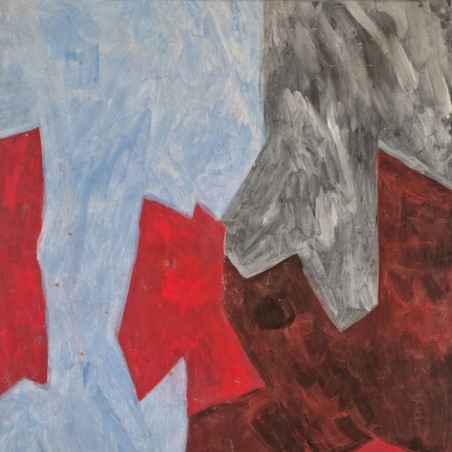
After figurative and post-cubist phases in the 1930s and 1940s, Poliakoff began a decisive turn towards abstraction at the end of the 1940s. He definitively renounces any reference to reality in order to develop a painting based on the articulation of interlocking chromatic planes. These forms, which are deliberately irregular, do not stem from strict geometry or free gesture, but from a system of internal balances where the composition is built up by tensions and successive adjustments.
For Poliakoff, color is the structuring principle of the work. It is never decorative or expressive in the lyrical sense, but thought of as a mass with its own visual weight, density and depth. Each chromatic field exists through its relationship to the others, in a closed organization, with no center or illusionist perspective. The pictorial surface becomes an autonomous space, entirely governed by the internal necessity of composition.
From the end of the 1950s, Serge Poliakoff's work was recognized as one of the major contributions to post-war European abstraction. It then entered the collections of several institutions, in particular the Pompidou Center, the Museum of Modern Art in the City of Paris and the Tate in London.
“Malevich showed me the crucial role of the vibration of matter. Even if there is no color, a painting where matter vibrates remains alive.” - Serge Poliakoff
An exceptional retrospective was dedicated to him in 2007 at the Espace Paul Riquet in Béziers.
.jpg)